Showing posts with label Creative Speech-Language Therapy. Show all posts

Thursday, August 15, 2019

Enough IS Enough

Next week I start my 36th year as an SLP. THIRTY-SIXTH YEAR! Somehow I thought it was 37, but I guess it just feels that way. :) I am fairly happy with where my journey has taken me. I've grown both professionally and personally, but haven't quite reached that point of complete satisfaction. I still compare myself to young SLPs with their cute Teachers Pay Teachers stores. I still compare myself to the seasoned ASHA SLPs with their positions and professional clout. I compare, I compare, I compare. ENOUGH!

I am reading Brené Brown's Daring Greatly and she purports that much of society's problems are rooted in the "fear of being ordinary." Our social media feeds are clogged with posts of people living seemingly extraordinary lives. I know when I see posts I think, "What am I doing wrong? Why doesn't my life look so spectacular?" Brown digs deeper and describes a "culture of scarcity." In our culture of scarcity we never have enough and sadly when comparing ourselves to the perfectionism social media and media in general underscores, we never will.


As I read, I thought about how I could combat this as I approach a new school year. It occurred to me a series of daily affirmations about what I have that is enough might be a great place to start. Now, this doesn't mean I stop here, I can always do more, but where I am today is good enough for today. Tomorrow will bring something else, another change, a growth moment. So without further ado...
As an SLP:

  • I am good enough
  • I am successful enough
  • I am competent enough
  • I am talented enough
  • I am creative enough
  • I am compassionate enough
  • I am smart enough
  • I am professional enough
  • I am thorough enough
  • I am empathetic enough
  • I am clever enough
  • I am valued enough
  • I am well read enough
  • I write well enough
  • I am organized enough
  • I have enough
  • I do enough
  • I am enough
As a human:
  • I am thin enough
  • I am funny enough
  • I am pretty enough
  • My house is good enough
  • My husband is good enough
  • My children are good enough
  • My car is good enough
  • My bank account is full enough
  • My clothes are good enough
  • I am fit enough
  • I run fast enough
  • I have enough
  • I am extraordinary enough
  • I am enough
I am enough for me and the handful of people who know, accept, and love me for me. You are enough. So let's stop comparing and start this year doing what we do best. Let's live and be content. WE ARE ENOUGH.


Friday, May 24, 2019

FunGames Speech Therapy Card Game : A Review

Finding high quality and engaging materials can be a challenge for the pediatric SLP, or any SLP for that matter. These days we have access to so many products and materials, it's hard to flesh out what will be useful across targets and age ranges.  We also want to make sure there is a long term usefulness. I often ask myself, "If I pull this out again next month, will my students be as excited as the first time I introduced it?" I also realistically have to consider if the product/material engages me! I want to be just as excited about what happens at my speech table as my students. Since so many of us spend our own money, the decision on where to invest becomes even more challenging and there is nothing more exasperating to me than having purchased and downloaded materials from TpT that have never been printed or used. I shudder to even think about how many products I have on my computer that have never been used. Consequently, hard goods have an appeal over digital products because they are front and center; manufactured, purchased, and ready to go, no printing, laminating, or cutting.

I was recently contacted by Maya, from FunGames, about a product she and her aunt, an SLP with 28 years experience, had developed. Their motivation was to design therapy materials that created solutions for some of the typical SLP challenges. The Express Game was born out of a desire for materials that offered enjoyable therapy, convenient card size, durable quality, crisp, clean, and real photos, common categories, relevant pictures, card flexibility, and box sturdiness.

Maya offered me a copy of The Express Game to review, no other compensation was provided. The following review contains my humble opinions only.

What I really loved about this product:

  • The Express Game comes in an extremely sturdy "shoebox" style box. It is visually appealing and for a tactile person like me, has a smooth finish.
  • Included in the starter set are 130-2.75 x 4.75 cards in 10 categories (clothing, fruit, vegetables, tableware, school supplies, musical instruments, cookware, furniture, and electronics).
  • The cards are brightly colored and feature clear, crisp photos without text. Again, as someone who notices texture, these cards have a really nice feel.  The cards themselves are waterproof and rip-proof. While I haven't done rigorous assessment of that claim, I can say, they are most definitely of sturdy quality. 


  • The textless nature of the cards allow them to be globally relevant and functional across any language. Some of the cards can be used for single word vocabulary activities while others can be used for developing words of classification as they feature several pictures belonging to the category.
  • Since the cards are real photos they can be used for any age and population.
  • This product is well suited across therapeutic and educational domains. Early educators, special educators, and  ELL teachers as well as an SLPs working with pediatrics and adults can find ample uses for these cards.
  • The cards are a practical size and are held easily by little hands.
  • The cards are easily used for individual therapy and group therapy.
  • The Express Game is very versatile and I have used it already with favorable results. It comes with a manual that includes many suggestions for therapy and games. 

  • An extension game is available here and includes 52 more cards in the categories of sports, camping, beach, and media.
  • The cards themselves are easily carried in a bag for use at multiple sites. SLPs will need to use their own bag for this and a small bag might be a nice addition to the product, so the entire box doesn't need to be carted site to site.
  • The interior of the box is slotted for convenient organization of the individual category decks with extra slots available for your own additions or the commercially available extension sets.
Other considerations:
  • Interestingly, there are no animals included in either product. I would like to have seen those in the starter set.
  • There are no blank cards included.
  • While the cards themselves are a great size for little hands, they are a little slippery.
  • Cards with text options might be useful, however, I do understand that would impact the global appeal.
  • When I originally ordered The Express Game, it was $59.93.  I consider that price somewhat high. I see the price is now $49.93 which I believe is more reasonable.
  • Transporting the entire box for the itinerant SLP, might be cumbersome. Including a cloth bag for carrying the cards between sites would be handy.
  • What makes the cards virtually indestructible is the fact that they are 100% plastic. From an environmental perspective I would like to see them made from a more sustainable material or even from recycled plastic. 
Overall, I am quite pleased with these cards and am excited to devise new ways to use them. I appreciate the opportunity to have given these cards a spin! Maya has generously offered a 20% discount for my readers (Thank you, Maya). You can find The Express Game here. Use the coupon code AnnieDoyle20 to receive 20% off the FunGame Original 130 Flashcards. This code will be available until June 25, 2019.
I would love to know if you purchase this product and I hope my review was helpful.


Tuesday, May 14, 2019

A Little Help with /r/

I have most definitely dropped the ball on my poor blog. I feel a little guilty, but I've been told guilt is only productive for about ten minutes. I should be over it by the time I'm finished writing. :)

I was working with a student today whose profile is fairly complex. We were working on /r/ using the "ka-la" technique. While we had the "ka" piece down the "la" was proving more of a challenge. I think this is because we previously worked on /l/ and curling the tongue way back is counter intuitive, given all our work on tongue placement for /l/. We have tried play-dough, used a mirror, flashlights, flossers, and the jumbo mighty mouth by Super Duper Publications. It was tough.  This student needed some feedback that just wasn't happening.  I pulled out the mini mouth finger puppet also from Super Duper Publications. I asked the student to simultaneously move the mini puppet tongue while producing the "ka-la."  Wonder of wonders it worked. My student could see and feel what the tongue should be doing for this method!

Now, how to maintain the connection for home practice? I whipped out some red felt, a red pipe cleaner, and my trusty glue gun. VoilĂ ! After trimming off the annoying glue threads and trimming around the felt a bit, we made sure it worked well with a few trials (it did!).  My student was super excited and now has a puppet to practice with at home.  Phew! Whatever it takes, right?


Monday, November 12, 2018

Progress Monitoring Resources for Speech-Language Therapy

About a two months ago (hard to believe) I was considering some new goals for a middle school student. I was feeling at a loss in terms of what I could use to monitor present levels. I have some tools that are quite effective, (my freebies are here and here) but I wanted to progress monitor his word finding skills and what I created just didn't cut the muster. I also have some progress monitoring tools I purchased and truth be told, I'm not thrilled with them.  So what to use?

I remembered some books that I used to use ALL. THE. TIME. When new materials become available my tried and true resources get relegated to the back of the cabinet. How sad! As I considered what I had available, I pulled out these materials that are perfect for progress monitoring all manner of targets. Here are a few I will be using now: HELP: Handbook of Exercises for Language Processing, Language Remediation and Expansion: 100 Skill Building Reference Lists, and BESST: Book of Exercises for Successful Semantics Teaching.Why purchase something new, when I already have great resources? These books contain wonderful lists for many, many language goal areas.


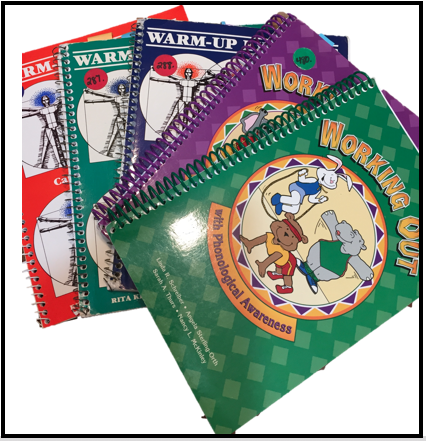
There are other sources like these that I think would be extremely useful when progress monitoring including this from Academic Communication Associates, Word Retrieval Activities for Children and these beauties from Thinking Publications.  I haven't used these in years and actually had to retrieve the Warm-up and Working Out books from my attic (did you notice I inventory all my materials?). I believe I bought the Warm-up books when I was I member of the mail order Speech Pathology Book Club! Who remembers that one?
It occurred to me as I was searching for what I thought I needed, that I need search no further than my therapy cupboards. I don't need anything newfangled, I don't need to buy anything else. I need to actually use what I have, because you know what? It's good stuff!

How about you? What do you already have that you can breathe new life into? 


Saturday, October 27, 2018

Going Green in Speech: Using Lamination Scraps

Like many of you, I find myself in a sea of excess laminating film that I just can't, in good conscience, pitch. It is my goal to reduce what I am throwing into landfills for perpetuity, so I have been both limiting what I laminate and squirreling away the excess for later use. I want to share only a couple possibilities.


First, rather than purchase page protectors and plastic sleeves, why not make your own? Here is a video of how to make your own. I use them as overlays for books when students are practicing articulation while reading. Using dry erase markers they highlight or underline any words with their target sounds. I also place worksheets in them and again, students use dry erase markers to complete the page. I can then send the same page as homework.


I've made them in varying sizes so I can put articulation or task cards in them for use with dry erase or as smash mats with play-dough. It keeps unlaminated cards clean and reduces waste. I made these for Texas Speech Mom's speech counters by folding a piece of laminating film and using washi tape to seal the two sides. I left the bottom a little higher than the top so I could easily insert and remove the cards.

Another fun and green idea is to save the cut off ends of laminated materials. They are perfect as makeshift whiteboards. I often cut them into strips and write words for practice or sentence formulation and expansion. I have a sentence frame and then have different morphological endings on each card that students can manipulate. Erase for a new sentence.
I don't have pictures of my scraps, but this is the general idea.
These scraps make targeting interrogative reversal a snap. I call it the "magic flip." Write a declarative sentence on the laminated scraps and then abracadabra, do the magic flip and formulate a question!

Do you have any handy laminating film hacks? I'd love to hear of the ways you use it. Please share!!

Thursday, August 16, 2018

Thoughts from the Back Porch: Summer Wrap-up

I've dedicated a couple of posts to our impending "empty nest." Here we are one week from the day we drop Mack off at school and I'm astounded by how quickly the summer has passed. When I was a teen, adults frequently remarked that time would seem to fly, so hold on to my youthful days. Hindsight is twenty twenty and I finally understand what they meant! I am returning to work next Tuesday.

My summer hasn't been all angst, however. In fact, there were days of hikes, gardening, kayaking, exercise, ASHA Connect, and reading on the porch. I also worked! For the first time in many years I provided speech-language therapy for students receiving extended school year services. It was really fun because I used all my ocean theme materials. I typically don't have enough time in June to use those particular materials. I thought it would be a nice idea to actually share some SLP related content (it's about time).
My perfect Pinnacle pepper.
As usual, I'm grateful for my pack rat mentality. I have repurposed so many of our children's toys for speech-language therapy that it has become easy to find items related to most any theme. The first item I dove for was Nora's felt board. We have a wonderful collection of "felt kids." I don't know if that particular brand is still available, but there are many other suitable brands. The therapy applications are plentiful, including following directions, basic concepts, vocabulary, narrative development, and sentence formulation and expansion.


I also have a wonderful magnetic fishing game that belonged to Mack. This wooden toy has numbers on one side and corresponding dots on the other. Remarkably, I'm only missing the number six fish. I taped cards to the fish as simple reinforcement. We used the dots on the fish for pacing multisyllabic words, too. I photo copied the dot sides of the fish, laminated, and cut them out and used paper clips to attach cards for the magnetic fishing pole.


I made some targets for use with my shark popper. I used the targets alone and with "speech targets" specific for each student.

Of course...books. What skill can't be addressed with books? Old School Speech has a wonderful book companion for Nugget and Fang that the children really enjoyed.


I have some super fun suction cup balls similar to these. We use them to pitch balls at targets on the whiteboard and laminated surfaces. I was able to enlarge this graphic using a free website called Block Posters. It is incredibly easy, if you don't mind cutting and pasting. I used dry erase markers to write points as well as words for articulation practice, vocabulary, etc.


I forgot to take a picture of Mack's awesome shark. When the fin on this baby is pushed, the jaw closes and can pick up small items. I used this with my mini objects for categorization, multisyllabic word practice, attribute identification, vocabulary, following directions and more. For simple and fun reinforcement I whipped up ocean-themed dot pages, used Putting Words in Your Mouth's Quick Drill Hungry, Hungry Sharky and Shark Biggy Mouth clip art from P4 Trioriginals. I love this clip art and use it all year long. It's nice to use simple reinforcement activities some days.

Whelp, soon I'll be in BTS mode and thinking of apples, leaves, and pirates. Stay tuned for more fun theme-based therapy ideas. I hope your back to school adjustment is seamless.

Tuesday, February 6, 2018

Helping Students Who Are Orally Defensive in Speech Therapy

I was working with a group of students last week and I wanted to help them grasp proper tongue placement for /s/. I pulled out the mirrors, tongue depressors, and toothettes when all of a sudden one second grader flipped out. With his hand covering his mouth he pushed himself away from the table and expressed with terror in his voice, "I don't like things in my mouth!" Okay," I responded, "no worries we don't have to use these." He remained fearful even with reassurance that I wouldn't come anywhere near him with the toothette. His peers on the other hand, were eager to use the cherry flavored tongue depressors. That session was lost for him and yet I still needed to help him understand tongue placement. I have a Super Duper Jumbo mighty Mouth Hand Puppet, but I wanted him to have a more personalized experience.

In the car on my way home (where all my ideas/thoughts happen) I decided that in order to have him develop comfort with his own mouth, he had to make one and not just a paper mouth, but a mouth where he could move the tongue. I've seen mouth craftivities with mini marshmallow teeth, but I wanted this one to be used more than once. I also didn't want to spend too much money as lately I've been a little too spendy. I ordered 1/4 inch white pom poms to be used as teeth and found pink baby socks at Walmart. I bought the 0-6 month size. I made a mouth template from card stock that the students traced on pink paper with a small rectangle where the sock tongue would be glued. Unfortunately, the pom poms didn't arrive in time, so we used crumpled tissue paper for teeth. I wish I had thought of that before I bought the pom poms!  I struggled stapling the tongue in when it occurred to me to use hot glue. I also trimmed about two inches of the sock cuff off, so there wasn't excess sock.

My little ones placed their fingers in the sock and moved it all around their mouths. They used tongue depressors and toothettes to touch all around the teeth and tongue. My colleague from our PK had a great idea to add some texture to the alveolar ridge I had drawn on. I think I'll outline it with white glue and sprinkle sand, glitter or salt on top. I'd like them to understand that the alveolar ridge is bumpy.

Years ago, I worked with twins one of whom was very orally defensive. His parents were at their wits end, because he was having considerable dental problems, yet they couldn't get him to the dentist. We are fortunate to have a dental program in our school whereby a dental hygienist comes and cleans students' teeth.  They asked for help so I ordered some dental tools. Never fear, they were never placed in the student's mouth, they were simply to desensitize him to the tools. He used them on the Jumbo Mighty Mouth and used the mirror tool to look in my mouth. It worked like a charm.
I'm fairly certain it's going to take repeated exposure "playing" with these mouths before this particular student becomes more at ease. It may never happen, in fact, but at least he will have  a greater awareness of his tongue in his mouth and will be less anxious when I pull out tongue depressors for use with his peers.

One last picture. I was able to find some white pom poms in my big ole bucket of pom poms, so one student glued them on his mouth as teeth. I actually think I like the look of the crumpled tissue paper better, plus there was no drying time because we used glue sticks.

Any other suggestions? How do you help your students with oral defensiveness? I am open to any and all suggestions!

Friday, February 2, 2018

Carnac The Magnificent in Speech-Language Therapy

I was working with a student last week, in science class. He was getting very frustrated with me because I was asking him about the group plan and needed to ask for clarification several times. What became very clear was that I didn't have all the information and he wasn't giving it to me in his responses, despite asking him clarifying questions. Herein lies the rub with social communication difficulties, "you think I know what you're thinking." I don't I'm not a mind reader!

In the car on my way home I was drafting my weekly email to his teachers...in my mind. I wanted to help them understand that our student has difficulty understanding that he has to communicate what he thinks and knows in order for us to all be on a level communication playing field, because we aren't mind readers. That notion jogged a memory of Johnny Carson and his Carnac the Magnificent character. How could I bring Carnac to speech therapy?

I immediately ordered a giant turban from Amazon because who doesn't love a little kitsch in speech? I plan on helping my student understand that others don't know what's on his mind using a mind reader scenario and some games from my therapy closet. I found three games I believe will lend well to this concept: Inklings, Buzzword, and Whoonu.


The object of Inklings is to write clues to help your teammates guess the seven answers on the subject card. The idea is to get your teammates to guess your seven answers using as short a clue as possible. More points are awarded for shorter clues.  For instance, if the subject is things that are yellow and the answer is lemon, a possible clue could be sour.  After we play using the subject cards provided with the game, I am going to add more social subjects such as relating an experience from school with answers including subjects, date, place, discourse, conclusion, etc.


Buzzword will be wonderful for helping students express a specific message. The object of Buzzword is to have your team guess the answers to the clues around a central theme. I think I am going to modify the rules so that the Buzzword isn't given at the outset of the turn, but needs to be guessed. So players would give the clues and the others would guess the theme or buzzword. I'll have to select specific cards and omit some more obscure clues, I think.


The last game I plan on using is Whoonu. In Whoonu players win the most points by correctly guessing other players' (the Whoozit's) favorite thing. The snag is that the players guess the Whoozit's favorite thing from the cards in their hands.

These games are introductions of sorts and will pave the way for more discussion and activities around sharing thoughts to improve communication. The bottom line is I want to help my student understand he bears a portion of the responsibility to provide information to others to prevent communication breakdowns as well as to learn to ask questions about what others may or may not know. I''l let you know how it works

Does anyone have any suggestions as to how I can make this different or better? I would love to hear your thoughts, I'm not a mind reader after all! :)


Wednesday, January 24, 2018

The Instax Camera in Speech-Language Therapy


While visiting family at the Jersey Shore this summer, my nephew's wife was taking pictures with the neatest little camera. I was surprised when the film shot out the bottom and developed right before my eyes! It was a blast from the past! Of course many of you will recall Polaroid cameras that provided instant gratification with a pretty badly developed picture. Well, Fuji has developed a new and improved version, the instax mini. It is small and convenient and comes in some kicky little colors. The picture quality is much sharper with vivid colors, than the Polaroids of the past. A number of different types of frames are available including rainbow, stars, solids, comics, and more. I immediately thought how this little gem could be used in speech-language therapy, but at 50 plus dollars, I put it on the back burner.

This Christmas my wonderful nephew and his sweet wife bought my children each an instax of their very own. Nora didn't take hers to school with her when she returned and so I asked if I could borrow it. Of course, she obliged. I have only just begun to explore how I can use this camera in therapy. The film is fairly expensive (I ordered the value pack here), but I think with the right applications it will be a great investment. If today's therapy session is any indication of how effective and motivating therapy with the instax can be, it will be entirely worth it.
Today students posed in a way to help them remember to use "new" speech sounds and adhered the photos to decorated reminder signs with washi tape. Their excitement was barely contained!


These little ones are leaving these pictures as reminders on their desks.
I've been brainstorming other uses for the instax including:

  • Students can write on an exit slip what they did or learned in speech-language therapy and take a photo. The picture can encourage discussion with peers, teachers, and parents and will be helpful in transfer of skills.
  • I like the idea of having students write their therapy goal as an "I can" statement and snapping a pic. Again these pictures can be the springboard for discussion afterward as well as reminder of why they are coming to speech. I ask students every time they enter the speech speech room what "they are working on." I then write their I can statements on the whiteboard. Using the photo will provide more of a personal connection to what they are participating in.
  • For social groups I thought it would be fun to take pictures of students showing different facial expressions or emotions.
  • Pairing two items in one picture, students can then do comparisons.
  • It might be fun to snap some candid shots and use them as the basis for a narrative.
I'm sure more ideas will come to me as I start using the instax, this is a pretty good start, though. I know you're all super creative SLPs, so if you have any ideas or suggestions, please comment. How would you use the instax in speech-language therapy?

Saturday, January 20, 2018

A Handy Social Skill Acronym

I've noticed a lot of references to "Say it, Think it" activities on social media as well as at workshops, recently. While it's gone by different names, this is not a new concept. Say it, think it activities are really helpful for helping students with social-pragmatic difficulties become more aware of blurting tendencies as well as putting that social filter into action.  So many of our students just say the first thing that pops into their heads, which leads to breakdowns in communication, problems with teachers and parents, and misperceptions by peers. Activities that help our students access the impulse control switch in their minds will serve them well in both school, social arenas and the workforce (as much as we might like to, we can't tell our bosses what we really think). As SLPs we use whatever is motivating and works;  wind-up mouths, squishy brains and mouths, sticky notes, and thought and speech bubble signs.  I really like these thought bubble and speech bubble sticky notes found on Amazon. I found the pictured squishy toys at Walmart.  There was an eye as well, but at $6.88 a toy, I exercised some purchasing restraint. These seem to be all the rage with the kids and they are super satisfying to squish.

I introduce the concept of a social filter by explaining the difference between thoughts and spoken words. That's easy enough, the former are quiet, known only to the student, and can be memories, ideas, words, or pictures.  Words are spoken and heard by all around the student. They have power and can make others feel a certain way or think certain thoughts.

We then practice. I present either a picture or a verbal scenario and give kids the opportunity to "blurt" the first thing they think of in the privacy and safety of the speech room. In doing so we can look at the impact of what they said on them personally and those around them. True story; I showed a video from the Everyday Social series to a student in speech therapy. It featured middle school students. My student's first thought (said aloud, of course) upon seeing the video was, "Well, he's never gonna get laid." This opened the door to the notion that a lot of what we think should not be uttered. In the context of speech therapy it is much easier to engage the social filter than when a student is emotionally triggered or trying to fit in socially.

Enter O.T.M. About twenty-five years ago, I was working in Hillsdale, NJ and I worked with an exceptional SLP. Geri, had created the aforementioned acronym and I use it to this day. O.T.M. stands for "keep It on The Mind, not Out The Mouth." I pair the acronym with the gesture of my index finger moving from forehead along the side of my face and out from my mouth. I like practicing this concept while doing in-class lessons. The whole class benefits and the teacher has some common language to reinforce the skill.


I can also dovetail using a social filter with plain old kindness. I really like the acronym THINK; is it true; is it helpful, is it inspiring, is it necessary, is it kind? Here is a little poster freebie for you highlighting the THINK  strategy. Click the picture or the link to be redirected to the download.

Well, I hope the O.T.M. strategy is something you bring to your speech programs and that you and your students find it productive. I'd love to hear if you use it!!


Saturday, January 6, 2018

It is Definitely Winter

Winter has arrived! In fact, it has arrived all across the country. There is snow in states that rarely see snow. In NH we have had 3 snow days already. January 2nd was our scheduled return to school. We had a two-hour delay due to cold (it was -22)! Last night it was -100 atop Mount Washington. That's some frosty weather. Yes, winter has arrived and in NH, it sticks around into April. This video captures the trip to my car yesterday!

After the frenzy and inconsistency of December, school-based SLPs are contending with more of the same because of weather and student absences. Next week I will be getting a little help from my friends who have authored some fun and therapeutically effective winter-themed materials. I decided to do a therapy week round up in order to "snowcase" these wonderful therapy activities. Since I will be using these activities next week, I don't have pictures of the products in action. Sorry. (My husband did get me a beautiful new camera for Christmas, so my pictures should be improving) All of these items can be accessed by clicking the respective images.


The first is Gold Country Speech's All Around a Winter Wonderland. Tracy's candyland-based game is perfect for mixed groups and more. She has included cards targeting problem solving, describing, wh-questions, multiple meaning words, following directions, articulation, AND a design your own option. Click here to grab this amazing product.


Laura, of All Y'All Need has created a series of jokes that are so fun to use in therapy. I've used her jokes for articulation, social pragmatics, fluency, and targeting ambiguities. They are "snow" punny and offer wonderful opportunities for discussion. Winter Jokes can be found right here.


Are you "yeti" for this one? Sparklle SLP's materials are the carrot for my snowman. She always includes a variety of materials that are perfect for mixed groups. "Mixed groups" seems to be the term du jour for how my groups have been for 35 years.  Homogeneous grouping is extremely difficult in our line of work, so I've always had to tailor my activities for multiple targets. Sparklle's Yeti packet targets "snow" much including: describing, comprehension, tier 2 vocabulary, informational text passages with QR code links, grammar and syntax practice, analogies, conjunctions, spatial concepts, positive reinforcement, AND recipes for snow and snow paint. To add an extra element of fun, this packet can be used as a complement to the game Yeti in My Spaghetti. Sled on over here to find it.


If you haven't used Small Talk SLP's Find it on the Go materials, ski, don't snowshoe, to get one. They are perfect for younger students and the format is easy to use and motivating.  Add to that a plethora of speech and language targets and you've got a winner. Pam has included multiple targets in three areas: concepts, receptive language and expressive language. While I don't laminate all my seasonal materials (I am trying to consider the environment before I wrap everything in plastic), I have laminated this one. I give my students a wipe-off marker and they draw right on the pages. It can be found here.


Mary of Old School Speech has put the "bomb" in "bomb cyclone" with her Joke Dominoes.  This game is played like traditional dominoes, which is fun because kids will then know how to play traditional dominoes! Joke Dominoes is a wonderful way to address articulation, fluency, social-pragmatics, multiple meaning meaning words, and more. It is easy to prep and easy to use and the price is right at $1.00. This winter staple can be found here.


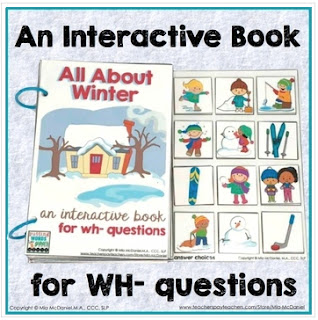
I "met" Mia many years ago, as a TpT customer. I have files on my computer named Mia. I remember a snow day many years ago, when I received an email from her, whereby she sent me her most recent winter product for free. She wrote something along the lines of, "You've been such a good customer, I want you to have this." It was the start of a lifelong friendship. Mia has created a wonderful series of interactive books that encourage true language interaction. Each interactive book comes with cue cards explaining what each wh-question answers. She then provides information about the theme and targets various questions along the way. I like her interactive books because they create a very naturalistic context for language therapy. Grab this Louisiana girl's All About Winter Interactive Book here.

I hope you see this post is about more than winter-themed products; it's about friendships and support. It's about how we all can try to make life a little easier for each other in a very demanding job. Oh, and for your wintry viewing pleasure here is the video of my return trek up the mountain to home.

Friday, July 28, 2017

Thoughts from the Back Porch 2017

 I am an artist. I have amazing, creative visions of drawings and paintings, mixed media works, and projects. Then I try to put these ideas on paper and poof, my hands don't procure what my mind envisioned. Why? I saw it so clearly in my mind, the color, the perspective, the light. I often look at my work and utter with disgust, "This is crap!" Sometimes I am brought nearly to tears. I look with awe and a fair amount of envy at the art of others and wonder, "Why was I behind the rock when the art gene was distributed?"

My family members have it. My grandfather was an accomplished artist who made his living by his hand. My cousin, Jeanette is an an artist. Her brother Christopher is an architect. My brother Jimmy is an amazing musician, playing the viola, piano, and composing. My other siblings are craftsmen and poets and writers. Why was I gypped? Oh the cruelty to have such a yen and not be able to create! But if I have the vision, why doesn't it translate to paper? There must be a way!

One of my strengths is perseverance and a desire for lifelong learning. This summer I began exploring how I can untether my creative juices and really make art happen. I started reading, Drawing on the Right Side of the Brain and it is fascinating! Not just from an art perspective, but from the educational and speech-language pathology perspectives as well.

This summer, I am going to go on a journey to tap into the right side of my brain, which is very counter intuitive for a left-brained language oriented sort of gal. I am going to share some of the nuggets I learn on this artistic journey in my Thoughts from the Back Porch 2017 series.


In her book, Betty Edwards, purports that drawing is an essential skill, like reading, that has implications for the perception and understanding of both visual and verbal information. She continues that our education system, that is so heavily language based is missing the mark in terms of cultivating creativity, perception, imagination, and intuition. This is fascinating. In her introduction, Edwards includes this quote from Albert Einstein, "The intuitive mind is a sacred gift, and the rational mind is a faithful servant. We have created a society that honors the servant and has forgotten the gift." Nowhere is this more prevalent than in our schools! Furthermore, with the emphasis on facts, standards, and standardized testing as the measures of competence, we see less and less competence and more and more behavioral struggles and anxiety in our students, who are, in fact, unable to think their way out of a paper bag.

Edwards includes a 1969 excerpt from Rudolf Arnheim that is striking in its accuracy, "The arts are neglected because they are based on perception, and perception is disdained because it is not assumed to involve thought. In fact, educators and administrators cannot justify giving the arts an important position in the curriculum unless they understand that the arts are the most powerful means of strengthening the perceptual component without which productive thinking is impossible in every field of academic study. What is most needed is not more aesthetics or more esoteric manuals of art education but a convincing case made for visual thinking quite in general. Once we understand in theory, we might try to heal in practice the unwholesome split which cripples the training of reasoning power."

This just intrigued me, that perception fosters productive thinking; reasoning and problem solving. We know this as it relates to social pragmatics, but it truly extends to all aspects of the curriculum and life in general. We talk ad infinitum of metalinguistics and metacognition, but what of the magnitude of those. The simple fact that the brain is the only organ that ruminates on itself! I had never thought of it in those terms. The liver doesn't think on the liver, the stomach on the stomach, the skin on the skin!

Edwards's premise is to waylay the language dominant left brain and allow the perceptual right brain to run the show for a while. I think this practice may change the way I do language therapy in that the verbal overload in school is so very taxing on our language impaired students. It raises the question for me, "Is more language always the way to remediate language?" "Will drawing help remediate perspective and reasoning?" The basic components of drawing are listed as:

  1. The perception of edges (seeing where one thing ends and another starts)
  2. The perception of spaces (seeing what lies beside and beyond)
  3. The perception of relationships (seeing in perspective and in proportion)
  4. The perception of lights and shadows (seeing things in degrees of values)
  5. The perception of the gestalt (seeing the whole and its parts)
The correlation between these components and social pragmatics is staggering to me!


The crux of this journey will likely be a challenge for this language infused individual.  It occurred to me as I was reading, that my self-talk is a boon and an axe. I use it to do my job and express my feelings, to make my unending points and to write. I also use it to sabotage myself, to quit when I'm exercising ("I can't. This is too hard.), to beat myself up ("This is no good.), to remind myself of my failures ("Remember when you couldn't/wouldn't/didn't?"). I am excited to pull away from the language Annie and cultivate the perceptual Annie and to share that journey here.


Monday, May 8, 2017

The Rockin' Tale of Snow White Meets CCC-SLP

Well it seems I have taken the month of April off from blogging. It wasn’t intentional (it usually isn’t, is it?). Spring in New England isn’t really the stuff of spring. There are glimpses here and there, but overall it is dreary. I expect spring to be chirping birds and daffodils and unfortunately in New England late March and early April often are chilly, sometimes snowy, and generally muddy. I guess I was in a funk.

I did have something fun and new to keep my mind off the lack of spring warmth, a play! I wasn’t performing this time, I was assistant directing our middle school play. A very different activity for me, but one I felt well suited for given my background in speech-language pathology. As I embarked on this challenge I was reminded of how theater and speech-language pathology are interrelated. In fact, I recalled thirty-three years ago when I was a graduate assistant. I had nearly forgotten that my time was split between two departments, communication sciences and disorders and speech and theater. How could I forget that? In working to help our students give a spectacular performance I was so happy to have a background in articulation, anatomy and physiology, voice, and social pragmatics. Here is how this all played out:
  • Articulation - I was dumbstruck by the number of girls who dentalized everything. Not only that, they didn’t voice /d/s and /z/s! They seemed to want to sound like all the Disney pop stars. On the other hand, some of the kids over-articulated their lines to the point where they sounded forced. Neither of those practises translates well to the stage and I was able to help them achieve better placement of their articulators for lines and singing.
  • Voice – The other piece of sounding like a Disney pop star is nasality. WHEW! We worked on establishing oral resonance when singing, but they always went back to Disney pop. I was also able to help our actors learn how to use their larger muscles as a basis of support for voice volume and projection and with the music director’s expertise how to adequately use breath support for both volume and pitch. We helped them recognize the difference between shouting while singing and supporting. We worked on appropriate rate and helped them understand that during performances when all that adrenaline was surging they had the potential to go even faster. 
  • Social-Pragmatics – This was the really fun piece: acting. My background in social was extremely helpful here. We talked about eye contact and body position on stage, remembering to never turn backs to the audience, but rather “cheating” out a tad. We worked heavily on not sending a mixed message. For instance, learning how not to laugh when telling the king that his wife has died or actually smiling when happy. By the same token, I helped the actors understand that it’s crucial to use a tone of voice that reflects the sentiment of the line that is being delivered. So if you are an evil queen you need to use a tone of voice and body language that is wholly evil. Performing in a play, like role playing in therapy, is a great opportunity for students to practice perspective taking in a non threatening and fun situation. It provides students the ability to stretch themselves as well as to consider the perspective of the other characters. I recall watching Robin Hood Prince of Thieves starring Kevin Costner. While overall I enjoyed the film, I was disappointed in Kevin Costner’s British accent. It seemed sometimes it was there and sometimes it wasn’t. Maintaining the integrity of the character played is as much a part of social as it is acting. We all assume different roles in different social scenarios. The work Annie is different from the home Annie who is different from the party Annie. They are all me, but they shift according to the scenario and other “actors.” This was a fun perspective to help our middle school actors understand. They still had to maintain their characters, but their character could shift as the context and other actors shifted in different scenes. 
The role of assistant director was new for me and I thank Monique for showing me what a good director does, as I performed in her plays. It was a wonderful distraction from my spring melancholy and despite being a ton of work was a fabulous experience, one I hope to have again.
Reflecting back, my colleagues and I had, what I consider, the perfect quantities of let’s make this good and let’s make this fun. We remembered when to be firm and when to laugh, when to remember this had to be performed and when to remember these are kids. We brought our own unique talents and strengths and I think we complemented each other perfectly. I am so grateful for my professional background, because without that expertise I think I may have missed the why behind the what in theater!

Sunday, March 26, 2017

It's Spring! Fresh Ideas for Speech Therapy


I used to love spring when I lived in NJ. The daffodils and crocuses would lift their sunny heads and the weather would warm up. Spring in NH is not nearly as nice. In fact, yesterday, the 24th of March, we got eight inches of snow. Earlier in the week we had indoor recess, because with the wind chill the temperature was below zero! After everything melts we get blessed with MUD. Oh the mud in NH! We live on a dirt road and it gets perilous! I learned early on after our move to New England to drive fast up the mountain in the snow and slow up the mountain in the mud. It seems counter intuitive, but that is how it works. Oh and try to stay out of the ruts!

I am fairly busy these days, so my therapy is going to be somewhat simple. Simple as springtime!


I realize I could go on, but I must stop somewhere and I need to get ready for a Saturday middle school play rehearsal! I hope these ideas inspire you to spring into spring with some fun and fresh therapy!! Enjoy and HAPPY SPRING (when it gets here!). Please link up with the Frenzied SLPs and share your springy ideas.